
Weekend Reading: The Worried Wealthy Edition
I work with a lot of clients who have done everything right. They saved diligently throughout their careers, paid off their mortgage, maxed out their registered accounts, and arrived at retirement with more money than they ever expected to have. And yet they’re worried.
Not about whether they can afford to retire – they clearly can – but about OAS clawbacks, sequence of returns risk, safe withdrawal rates, and whether their portfolio can survive a market crash in year one of retirement.
The irony is that the very habits that made them wealthy are now working against them, because the worried wealthy are almost always focused on the wrong things.
Take the savings rate problem. People who saved aggressively throughout their working years were, by definition, living on much less than they earned.
Old habits die hard, and while many clients imagine they’ll flip a switch in retirement and suddenly spend 150% or 200% of what they spent while working, in reality they tend to keep spending roughly what they spent in their final working years.
My job isn’t to rein them in – it’s to nudge them toward enhancing their lifestyle with travel, hobbies, and entertainment, and to weave in periodic lump-sum expenses for vehicle replacements, home renovations, and financial support for kids and grandkids.
Then there’s the OAS clawback anxiety, which I’d estimate affects the majority of my worried wealthy clients in their imaginations but only 8.3% of recipients in reality.
With pension income splitting and some basic planning in your 60s, most people can reduce or eliminate any clawback entirely.
As for sequence of returns risk: the 4% guideline exists to show the maximum you could safely withdraw from a portfolio over 30 years without running out of money.
But the worried wealthy aren’t spending anywhere near that ceiling. They have cash wedges for their cash wedges, two TFSAs they’ll never touch, and once CPP and OAS kick-in they’re swimming in guaranteed income while their net worth continues to grow.
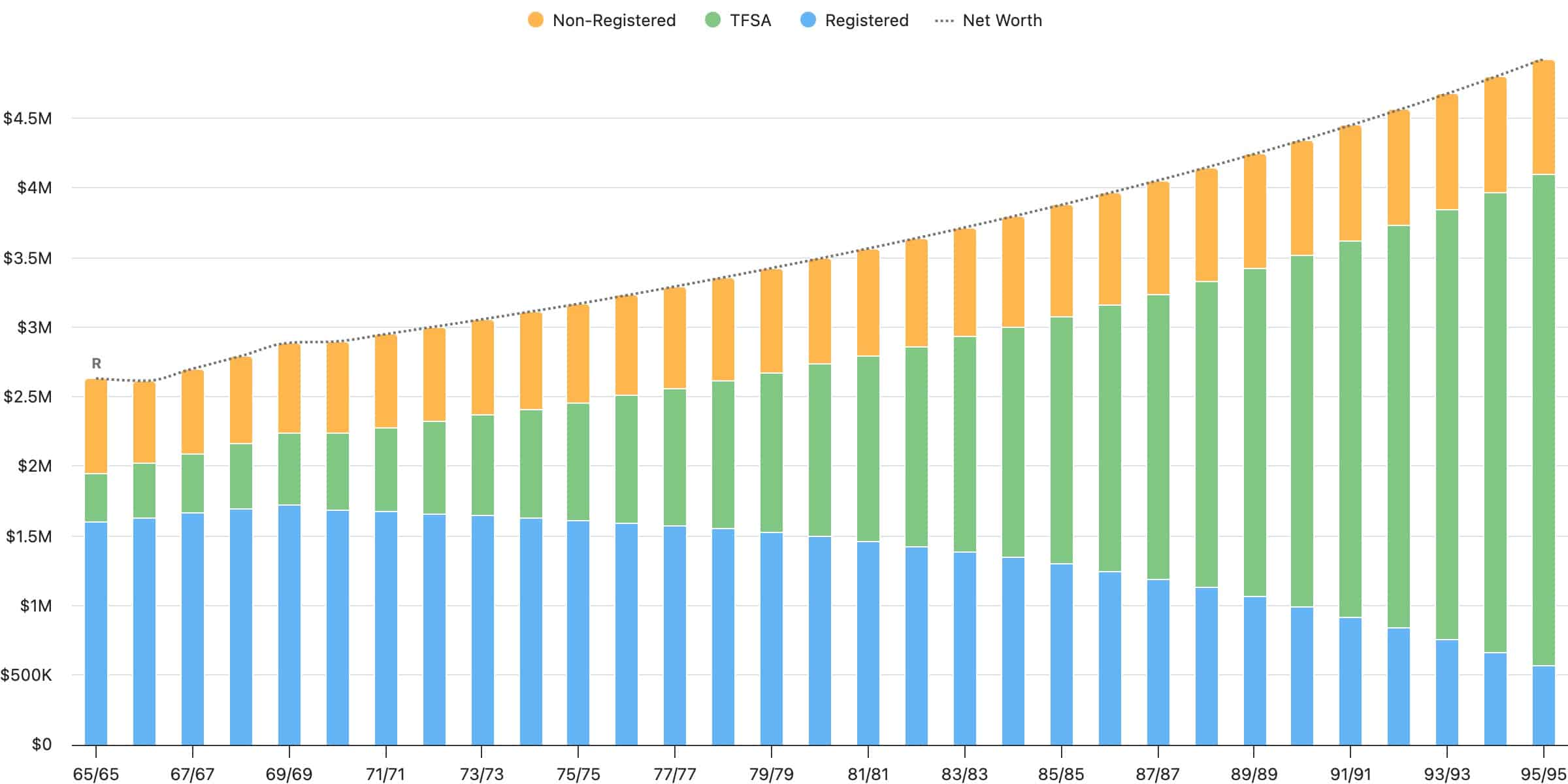
Which brings me to the TFSA problem. Many of my higher-net-worth clients are underutilizing their TFSAs – holding cash or conservative investments inside an account they’ll likely never draw from and will continue contributing to for the rest of their lives.
That’s backwards. If you’re never going to touch your TFSA, you should be investing it like a 30-year-old would: higher equity allocation, long time horizon, maximum tax-free compounding.
The practical result is a rising equity glide path where your RRSP and non-registered accounts are invested more conservatively to support withdrawals, while your TFSA compounds aggressively in the background, completely sheltered from tax.
If you want to hear more on this topic, I’ll be back on The Wealthy Barber podcast (recording this week, publishing TBA) to discuss exactly this – the worried wealthy, and why so many high-net-worth retirees are anxious about all the wrong things. Stay tuned for that one.
This Week’s Recap:
In the last edition of Weekend Reading I explained (again) why dividends are not free money.
After I filed my tax return last month I remembered that both of our kids got braces last year and we could claim the costs as a medical expense. We filed again (reassessment) and got back an additional $2,100 in taxes!
Weekend Reading:
A Wealth of Common Sense blogger Ben Carlson reveals the four abilities every investor needs to be successful.
Ben also wrote a new book on risk and reward, and he went on The Long View podcast to discuss the book, what investors can learn from past bubbles, and the role of complacency in today’s market environment.
The New York Times interviewed personal finance author Ramit Sethi about what millennials need from their boomer parents:
“More sophisticated financial planners now know that if you have something to give, giving is much more impactful when your children are younger, particularly when they’re 35, 40, 45. Those are really tough financial times for people. But the best thing that older parents can do is to actually ask their children and legitimately learn what is going on financially because it is not the same.”
In this CBC Go Public feature, WestJet is accused of a tricky manoeuvre to deny dozens of passengers compensation after flight cancellations.
On The Wealthy Barber podcast Dave Chilton and Mark McGrath discuss all-in-one ETFs, rent vs. buy, and financial trade-offs:
Should you pay your tax instalment payments? Jason Heath explains why quarterly tax instalment payments are suggested payments, not balances owing.
This investor plans to rescue empty condos by buying them up and turning them into long-term rentals.
Finally, for Globe and Mail subscribers, why your retirement savings target is probably lower than you think.
Have a great long weekend, everyone!

“Then there’s the OAS clawback anxiety, which I’d estimate affects the majority of my worried wealthy clients in their imaginations but only 8.3% of recipients in reality.”
Well, if they are “wealthy” then by definition they are a subset of recipients and their personal reality/likelihood is quite a bit more than 8.3%. If they are “wealthy” ($5M for a couple? $10M? $20M?) then it has to be close to the probability of 1 regardless of income splitting. And if its 8.3% (aka median) then their sequence of return risk is very real.
Ok, I have no idea about the actual numbers among your clients but still curious how you define “wealthy”. Usual subconscious definition is “someone with a little more than me” but you have to be more specific to make this post clear.
I think TFSA is an awesome emergency pot. We try to aim for fairly consistent average taxation rate now and in retirement. And like you say, one may need to work to increase expenditure rate to make it happen. But what happens if you need to buy a new car or help a family member in emergency or get a really expensive health procedure abroad? That’s where TFSAs become instrumental. You can draw without forcing your tax rate for this year to skyrocket and replenish over time.
Wealthy is a pretty subjective term. And your net worth may have little to do with OAS clawbacks, particularly for couples and for those who retire relatively early. It’s all about income.
I’m talking about the type of people who spend $60,000 per year but can comfortably afford to spend $120,000 or more. They never exercised their spending muscles – to the point of atrophy.
Or a couple with defined benefit pension income that comfortably meets their regular spending needs (before CPP and OAS), who fret over the daily gyrations of the market.
Wealthy to me is never having to worry about money. Yet many people who I’d consider to be wealthy are some of the most anxious about money.
No, they do not need to worry about sequence of return risk in a properly diversified portfolio because their required rate of return might be 1-2%.
Ok, this makes me curious about specifics. In my book a couple who can safely spend $120K a year at age 55-60 is almost guaranteed to get into OAS clawback territory by the time they are in their 70s. So say Monte Carlo simulations and all but the most extreme, low probability “disastrous” scenarios.
Their gross annual income has to be more than $120K to allow this kind of spending. And 4% SWR isn’t really “safe” for them as they may have more than 40 years to go and its a simplistic rule of thumb anyway. So we are into 4-5M territory. And one can reasonably expect net worth to grow above inflation between now and 71.
Ok, some of it depends on the exact make up of their pots and income streams but still…
Oh boy, where to start? You might be part of the worried wealthy!
The OAS clawback starts at $93,454. A couple could have $187k in taxable income before even being affected by the clawback.
Spending is not entirely correlated with taxable income, either.
Withdrawals from non-registered accounts are extremely tax-friendly. Take money out of your savings account, no tax. Sell some appreciated shares, only 50% is taxable.
The 4% rule is not at all useful because you’re ignoring CPP and OAS (x2). So, no they don’t need $4M or $5M because they’re not withdrawing anywhere close to $120k from savings and investments once you factor in government benefits.
In summary, a couple can spend a lot more than $120k after-taxes and still not be affected by the OAS clawback. It is one of the biggest myths of retirement planning. Unless you’re working into your 70s (or late 60s) and don’t give yourself a proper runway to do some tax planning, it’s unlikely that you’ll be affected by the clawback.
It is true that a couple can spend a lot more than $120K before being impacted by the claw-back. Even according for inefficiencies in the non-reg portfolio, eg the treatment of Canadian divs.
And its true that my Monte Carlo simulations leave quite a bit in the pot at the end – for most scenarios. The key word is “most”. I think its reasonable to err on the side of caution because the consequences of underspending are far less drastic than the other way around. And yes, I could afford to retire at 55 but its a lifestyle choice what one does rather than just finance.
Either way, the most efficient and sufficiently safe model of spending involves getting next to no OAS from 71. I will actually start drawing at 65 because that will be the only time I can draw any, before CPP and another DB income kicks in.
And its not something I fret about; focusing on maxxing OAS would involve either 1. Unacceptable sequence of return risk or 2. Uneven tax profile across the years to the extent it would be counterproductive. So its not a worthy priority.
Listen, I’m not out here advocating that people spend recklessly and aim to “die with zero” without any margin of safety. I’m just saying if the spending floor is $60,000 and the spending ceiling is $120,000 it might be okay to bump up spending to $80,000 – $90,000 and live a little…maybe gift some money to your kids earlier than 95 (when they’re 65).
It’s a well documented problem. Retirees are loath to spend from their own savings (yet they loathe annuities and delaying gov’t benefits).
David Blanchett’s research showed that spending (i.e., withdrawal) rates from savings were only approximately 2.1% for 65-year-old married households and 1.9% for single households.
It’s a shame to live a significantly smaller life than you can afford to because you’re afraid of the myriad of what-ifs that might occur. Behavioural psychology is already working against us. We don’t need to succumb to doomerism.
Agreed. And we did increase spending a lot having done the projections. But… I am 56; you need a larger margin of safety than (say) a 70 year old. And that means I am not “worried”.
I’ve come to realize I don’t hesitate to spend at age 69 but more on trips to visit family in the UK or fund a trip for 5 to Portugal or Cyprus..
My experiences with contractors has been dismal, to the point where I should have, and could have done the work myself. I’m getting tired of doing the work myself.
We’ve never wasted money on vehicles for prestige however my first yr retired i bought a new to me 1 yr old pickup, a new high quality boat/motor/trailer to go with the small island we bought a year before retirement.
We annually fund one kid’s TFSA, the other we reduce his medical school debt but are in no rush to shower them with cash. They stand on their own two feet as they should.
We still live kinda frugally day to day. Maybe because the best restaurant in town is at home.
Hi Charles, this sounds very much like us. We’re happy to spend extravagantly on travel, but stay home when we’re home and don’t spend much on food & drink.
I’d be thrilled if I never had to buy another vehicle again.
Like you, I’ve also had poor experiences with contractors – which, as Canada’s worst handyman, is not ideal.
We’re fortunate to be in a position to help our kids out through post-secondary and maybe FHSA/TFSA if needed.
Can’t wait for the wealthy barber podcast Robb!
Glad you’re going on for round 2!
Very excited, Ravi! I can’t wait to jokingly blame Dave for causing the worried wealthy crisis. After teaching a generation to pay themselves first – they just can’t seem to stop!
As one of Dave’s and yours biggest fans, I’m really looking forward to this episode!
If I end up in the position that I have OAS clawback it’s because my investments have done incredibly well and I’m richer than I anticipated, how that can be interpreted other than a win is beyond me.
This 👆 is the problem we can all work to have. Working diligently to get there ourselves.
100% agree, Paul. Besides, the clawback mostly affects people working well into their late 60s and 70s (when employment income collides with CPP, OAS, and RRIF minimums). And singles are disproportionately affected as well, with no income splitting partner available.
First world problems, indeed. It would be like me complaining that I don’t get the Child Benefit anymore because our income is too high. Well, our income is too high – so, of course we were cut off!
Hi Robb. As usual, your articles are easy to follow and relatable. I filed my income taxes too and forgot to declare my annual travel insurance premium as medical expenses. I re-filed and received a $350 adjustment to my tax bill. Have a great long weekend!
Excellent, Tom! Thanks for sharing.
I am one of the 8.3%. Not due to poor planning but the death of my wife. Gone was pension splitting.
However, considering I’m quite well off and certainly in better shape than young working families, I can’t get too upset on having my OAS clawed back.
Good article Robb. As always, very interesting and food for thought.
Hi VLW, so sorry to hear about your wife. Yes, your situation is one of the more common ones resulting in OAS clawbacks – with no pension splitting partner and a higher proportional cost of living. Appreciate your comment and the kind words. All the best!
Robb – I am in my mid-70s and wonder whether your suggestion to choose investments for a TFSA like someone in their 30s would choose really suits me. My TFSA is maxed out with mostly GICs after making a poor choice to buy a losing REIT ETF. Not being able to claim a tax loss for investment inside a TFSA bothers me.
Hi Greg, thanks for your comment. It’s a natural reaction to invest more conservatively after suffering losses with riskier investments. And you’re not wrong to note that capital losses cannot be claimed inside of a TFSA.
When I say invest more aggressively I mean if you hold a balanced fund in your RRSP, you might opt for a growth fund in the TFSA.
I don’t mean to pick meme stocks and crypto hoping for a lottery like return.
“They have cash wedges for their cash wedges” – ok, I laughed out loud on that one. Good article.
OAS is NOT an entitlement.
As someone who, being single, has been subject to 100% OAS clawback forever, I remain amazed by the number of people who get hung up on this because they’re convinced it’s a entitlement that they are missing out on. It’s not. Get over it.
OAS is a safety of 100% tax-payer dollars that’s there in the event that you can’t fund a comfortable retirement through your CPP, your other pensions & your savings. You paid into CPP so you are of course entitled to collect.
Yes, you paid into OAS through general tax revenues. But it’s an income safety-net scheme folks, not a entitlement.
I for one am looking to a government that has the fortitude to lower the OAS clawback thresholds. How is a couple with an annual income over $200,000 entitled to collect OAS, and, as they invariably do, at the same time complain about the lack of good health care and too-high university tuitions for their grandchildren, and poor roads, and so on and so on?